

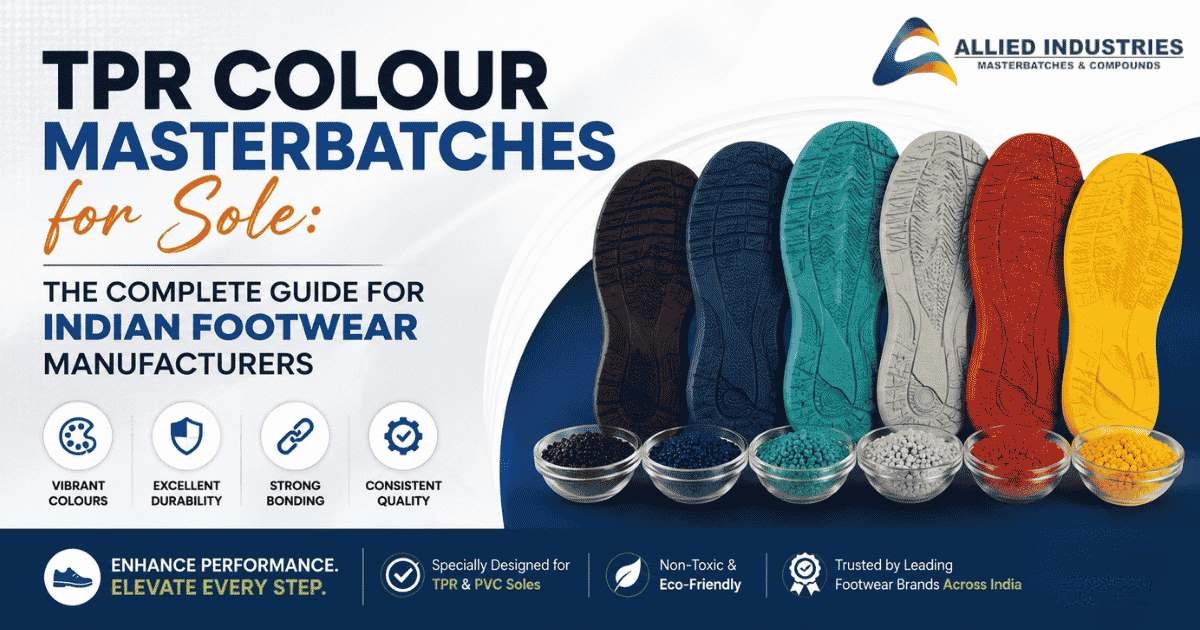
TPR Colour Masterbatches for Sole: The Complete Guide for Indian Footwear Manufacturers
How the right masterbatch determines colour accuracy, abrasion resistance, and batch consistency - and why choosing the wrong one costs you more than you think.
TPR colour masterbatches for sole are the fastest, most consistent way to colour thermoplastic rubber soles without compromising abrasion resistance or processing efficiency.
- Consistent shade across all batches
- REACH & California 65 compliant grades available
- Works across injection moulding & direct moulding
- Reduces rejection rates and production downtime
- Custom shades formulated in-house by Allied Industries
- Suitable for ladies', gents', and kids' footwear
A shoe sole that looks different in every batch is a quality problem no buyer will forgive. TPR colour masterbatches for sole are the upstream fix - the point in your production process where colour precision, performance, and efficiency are built in, not corrected later.
India's footwear industry produces over 22,000 million pairs annually (as per industry estimates - verify with CLE/FDDI for the latest figure), making it one of the largest in the world. In that environment, colour consistency is not a luxury. Buyers from domestic retail chains to international importers specify Delta E tolerances, REACH compliance, and repeat-order colour accuracy. A single rejected shipment wipes out the margin on an entire season.
This guide explains exactly how TPR colour masterbatches work, what separates good from poor formulations, and how to select the right grade for your specific sole application - whether you are running injection moulding, direct-to-sole moulding, or sheet extrusion.
What Is TPR and Why Does It Demand a Specific Masterbatch?
TPR is the dominant material for sole manufacturing in India's mid-range and export footwear segments. It offers a good balance of softness (typically 40–75 Shore A hardness), abrasion resistance, and recyclability. The material is processed at melt temperatures of roughly 160–200°C, depending on the grade.
The challenge with colouring TPR is its chemical nature. TPR contains styrene-butadiene-styrene (SBS) or styrene-isoprene-styrene (SIS) segments. Pigments that work well in polyolefins can show poor dispersion, migration (colour bleed), or reduced abrasion resistance when added incorrectly into TPR.
A well-formulated TPR colour masterbatch uses a carrier resin that is compatible with the specific TPR grade you are processing. The pigments are pre-dispersed under high shear in that carrier, so when you add the masterbatch to your natural TPR compound, dispersion is immediate and uniform - no specks, no streaks, no shade drift between morning and evening shifts.
Key takeaway: Generic masterbatches are not suitable for TPR sole compounds. The carrier, pigment selection, and dispersion method all need to match your specific TPR grade and processing conditions.
What Most Articles Miss About TPR Colour Masterbatches for Sole
Here is what the product datasheets rarely explain:
Carrier resin compatibility
A masterbatch made with an EVA carrier disperses differently in SBS-based TPR than one made with an SBS or oil-extended rubber carrier. If the carriers are incompatible, you get a mottled surface - not because the colour is wrong, but because the masterbatch and your compound are essentially not mixing at the molecular level.
Heat stability window
Some organic pigments that produce vivid reds or yellows are not stable above 180°C. If your injection barrel runs at 185°C, those shades will degrade - either fading during moulding or releasing decomposition products that affect the surface. A reputable masterbatch manufacturer will specify the heat stability window clearly.
Expanded TPR soles
Expanded (microcellular) TPR soles are lighter and more comfortable, but the foaming process — which involves blowing agents releasing gas - can interact with certain pigments or process aids in the masterbatch. In practice, based on formulation experience, masterbatches for expanded TPR soles require lower volatile content and specific dispersion aids that do not interfere with cell nucleation.
Most generic masterbatch suppliers in India offer a single TPR grade without differentiating between standard sole compounds, expanded TPR, and two-colour (dual-shot) sole applications. Allied Industries formulates separate grades for each processing route - which is why shade consistency and surface quality are substantially better in demanding export programmes.
Benefits of TPR Colour Masterbatches for Sole
Consistent shade, every batch
Pre-dispersed pigments in a fixed carrier ratio mean you get the same Delta E reading from Monday morning to Saturday evening, regardless of which operator loads the hopper.
Better abrasion performance
Poorly dispersed pigments act as stress concentrators in the TPR matrix. Fine, fully dispersed pigments from a quality masterbatch do not weaken the polymer network, so Taber abrasion values stay where your compound formulator intended them.
Compliance-ready formulations
Masterbatches from Allied Industries are formulated to meet REACH restrictions and California Proposition 65 standards - the two compliance frameworks most commonly required by European and US footwear importers.
Colour flexibility without downtime
Switching from a black casual sole to a white sports sole in natural TPR takes minutes with a masterbatch - versus hours if you are running pre-coloured compounds that require full purging cycles between colours.
Reduced pigment dust exposure
Loose dry pigments create dust that is both a health risk for workers and a contamination risk for adjacent production lines. Pelletised masterbatch eliminates both problems, supporting a cleaner, safer factory environment.
Custom shade matching in-house
Allied Industries maintains a dedicated R&D and shade-matching unit. When a buyer sends a Pantone reference or a physical sole sample, a matched masterbatch grade can be developed and validated without sending samples to a third-party lab - saving 5–10 days on development lead time.
How to Select the Right TPR Colour Masterbatch for Your Sole Application
Identify your base TPR compound grade
Share the technical datasheet of your TPR compound - or at minimum the polymer type (SBS, SIS, or SEBS) and the Shore A hardness - with your masterbatch supplier. This determines carrier compatibility and the maximum acceptable pigment loading.
Confirm your processing temperature range
Most injection moulding of TPR soles runs between 165–195°C. Knowing your exact barrel and mould temperature tells the formulator which pigments are safe for your process and which need to be substituted with higher heat-stable alternatives.
Specify shade, finish, and effect
Plain solid colours are the simplest case. For marble effects, granite effects, pearlised, or metallic finishes on TPR soles, the masterbatch formulation is more complex. Specify the exact effect with reference samples or Pantone codes upfront to avoid multiple development rounds.
Check compliance requirements for your market
If you export to Europe, check REACH SVHC candidate lists. If you supply US importers, ask for Proposition 65 clearance. For domestic supply, confirm BIS requirements if applicable. Request compliance documentation - not just a verbal assurance - before approving a masterbatch.
Run a production trial at recommended let-down ratio
The typical let-down ratio for TPR sole masterbatches is 2–5% by weight, depending on the shade depth required. Run the trial under your actual production conditions - not a lab simulation - and evaluate colour consistency across at least three consecutive production cycles before approving the masterbatch for regular use.
Colouring Methods for TPR Soles: Which Approach Works Best?
"In production, colour is not a cosmetic detail - it is a process variable. Get the masterbatch right and everything downstream gets easier."
Expert Tips for TPR Colour Masterbatches in Sole Manufacturing
Store masterbatch away from direct sunlight and moisture
TPR masterbatch pellets are hygroscopic to varying degrees depending on the carrier. Moisture absorbed during storage leads to surface defects and splay marks on the moulded sole. Store sealed bags in a dry, shaded area at temperatures below 30°C - and always dry masterbatch at 60–70°C for 2–3 hours if bags have been opened for more than 24 hours before use.
Do not exceed the recommended let-down ratio chasing deeper colour
Loading more masterbatch than recommended to achieve a darker shade overloads the polymer matrix with pigment and carrier, which can reduce abrasion resistance and surface hardness. The better solution is to ask your masterbatch supplier to reformulate at a higher pigment concentration — not to add more masterbatch on the line.
Request a migration test for white and bright colours in contact with upper materials
White and fluorescent masterbatches in TPR soles can migrate into the shoe upper if the organic pigments used have insufficient fastness ratings. Before approving a masterbatch for a sole that will be bonded directly to a light-coloured fabric or leather upper, ask for a migration test result per ISO 105-E04 or equivalent.
Align masterbatch development with your seasonal colour calendar
Shade matching and production trials take 2–4 weeks for standard colours and up to 6 weeks for special effects. If you are developing seasonal footwear collections, initiate masterbatch development 6–8 weeks before your planned production start - not 1 week before, when there is no time to correct a shade that is slightly off.
Request retention samples from every approved batch
Keeping a 200g retention sample from each approved masterbatch batch allows you to cross-check against future deliveries. If a reorder looks slightly different on the sole, compare it against the retained sample under standard D65 lighting - not under the factory's fluorescent tubes, which often give misleading colour readings.
Frequently Asked Questions About TPR Colour Masterbatches for Sole
What is a TPR colour masterbatch for sole and how does it work?
A TPR colour masterbatch for sole is a concentrated mixture of pigments dispersed in a thermoplastic rubber-compatible carrier resin, supplied in pellet form. During sole manufacturing, the masterbatch is added to the natural or base TPR compound at a set let-down ratio - typically 2–5% by weight. The pellets melt and mix uniformly in the barrel, delivering consistent colour throughout the moulded sole without affecting the physical properties of the compound.
How is a TPR masterbatch different from a PVC or EVA masterbatch?
TPR, PVC, and EVA have different chemical structures, processing temperatures, and additive interactions. A PVC masterbatch uses a PVC-compatible carrier and may contain heat stabilisers specific to PVC. An EVA masterbatch uses an EVA carrier. Using the wrong masterbatch in TPR typically results in poor dispersion, surface defects, or phase separation. Always use a masterbatch formulated specifically for TPR with the correct carrier and pigment selection.
What let-down ratio should I use for TPR sole masterbatches?
The standard let-down ratio for TPR colour masterbatches for sole is 2–5% by weight, meaning 2–5 kg of masterbatch per 100 kg of TPR compound. The exact ratio depends on the shade depth required - deep blacks and dark navy shades typically run at 3–5%, while pastel and transparent tints may require only 1.5–2%. Your masterbatch supplier should confirm the recommended ratio for each specific shade during the development phase.
Are TPR colour masterbatches REACH and California 65 compliant?
Compliance depends entirely on the specific pigments and additives used in the masterbatch formulation. Allied Industries formulates TPR masterbatch grades for export programmes using pigments that meet REACH SVHC restrictions and California Proposition 65 requirements. Always request formal compliance documentation - test reports or Declaration of Conformity — from your supplier before approving a masterbatch for export orders. Do not rely on verbal assurances alone.
What is the best TPR colour masterbatch for white shoe soles?
White TPR soles require a titanium dioxide (TiO₂)-based masterbatch with a high whiteness index and excellent UV stability, since white soles yellowing in sunlight is one of the most common quality complaints in the footwear market. The masterbatch must also be tested for migration, as TiO₂ and optical brighteners can transfer to adjacent materials. Allied Industries offers white masterbatch grades specifically developed for TPR soles with anti-yellowing performance and migration-tested formulations.
Can I get custom colour masterbatch for TPR soles in India?
Yes. Allied Industries has an in-house shade-matching and R&D unit in New Delhi that develops custom masterbatch formulations for TPR soles against Pantone references, physical samples, or spectrophotometer data provided by the buyer. Development lead time for standard solid shades is typically 2–3 weeks. Effect colours (marble, granite, metallic, pearlised) take 4–6 weeks. Contact Allied Industries at masterbatchin.com to initiate a development enquiry.
How much does TPR colour masterbatch for sole cost in India?
Pricing varies based on the specific pigments used, the shade complexity, and order volume. Standard carbon black and TiO₂-based masterbatches are at the lower end of the cost range. Organic pigments - particularly vivid reds, blues, and special effects - carry a premium due to raw material costs. Request a formal quotation from Allied Industries based on your exact shade, volume, and compliance requirements for an accurate landed cost calculation.
Getting colour right in TPR soles is not complicated - but it does require the right masterbatch formulated for the right polymer, at the right dosage, with the right compliance documentation behind it. TPR colour masterbatches for sole reduce rejection rates, speed up colour changeovers, and give buyers the shade consistency they demand across repeat orders.
The footwear market in India is growing, and export requirements are getting stricter, not looser. Manufacturers who build colour quality into their process - through properly formulated masterbatches - protect their margins and their reputation simultaneously.
With over four decades of masterbatch experience and a dedicated in-house R&D unit, Allied Industries is positioned to support footwear manufacturers at every stage of that process - from initial shade development to certified, production-ready masterbatch supply.
Ready to Get Your Sole Colour Right?
Allied Industries has been the preferred masterbatch partner for Indian footwear manufacturers since 1982. Share your TPR compound details and target shade - and our team will respond with a matched masterbatch recommendation and a formal quotation.